
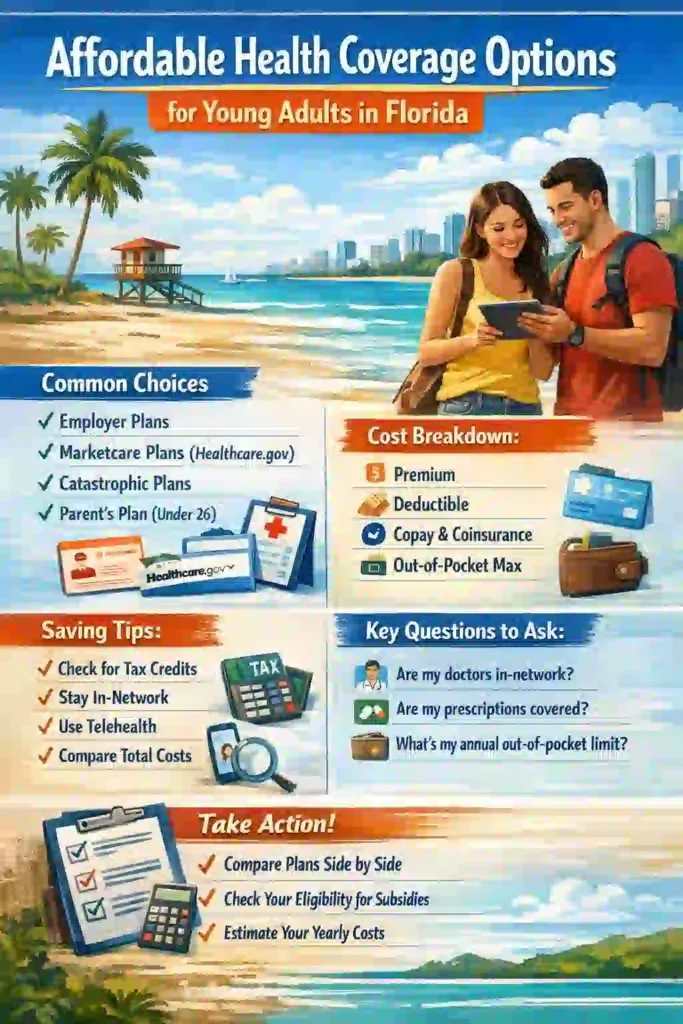
Experienced insight you can use to actually find the right plan — without overpaying or getting stuck with coverage you don’t need.
Table of Contents
Affordable Health Coverage Options for Young Adults in Florida
If you’re a young adult living in Florida, navigating health insurance can feel overwhelming. You might be graduating from college, starting a new job, juggling freelance gigs, or trying to balance work and life while also figuring out how to protect your health and finances. Affordable health coverage isn’t just a “nice-to-have” — without it, a single accident or unexpected diagnosis can lead to crushing medical bills.
The good news? There are affordable options that make sense for people like you — if you know where to look and what to ask. In this article, we’ll break down everything you need to know about health insurance in the Sunshine State, including:
- What coverage options exist and how they work
- How much you can realistically expect to pay
- Hidden costs and common pitfalls
- How to choose a plan that fits your lifestyle
- Practical strategies to save money
- A clear comparison of major providers and programs
No jargon. No confusion. Just clear, practical guidance based on real experience.
Why Health Insurance Matters (Even if You’re Young and Healthy)
Let’s start with a hard truth: being young doesn’t make you invincible.
Accidents happen. Chronic illnesses can emerge unexpectedly. Prescription costs keep rising. Even if you’re generally healthy, a single ER visit can cost thousands of dollars — and without insurance, you’re responsible for every penny.
Insurance protects your financial future. It spreads risk across a large group so that unpredictable, expensive events don’t become personal financial disasters.
In Florida, where healthcare costs tend to be higher than the national average, having coverage isn’t just smart — it’s essential.
Young Adults & Health Insurance: Common Real-World Scenarios
Here are the life situations where most young Floridians find themselves — and the insurance questions that go with them:
- College or recent graduate — “Do I stay on my parents’ plan? When does that end? What’s next?”
- Freelancer / gig worker — “I don’t have employer coverage. What affordable options exist for me?”
- Part-time worker — “My job doesn’t offer insurance — am I stuck with expensive individual plans?”
- Low income or hourly wage — “I want coverage but can’t afford big premiums.”
- Healthy but cautious — “I don’t want to pay for a lot I won’t use — how can I stay protected on a budget?”
Each of these situations requires a slightly different strategy, and the costs and choices vary a lot. Let’s explore them.
Understanding Health Insurance Basics (Plain English)
Before we dive into specific options, let’s quickly cover core concepts you’ll need to make informed decisions.
Premium
This is the monthly amount you pay simply to have coverage. Even if you never see a doctor, you still pay the premium.
Example: $250/month premium = $3,000/year before you ever use a dime of coverage.
Deductible
This is the amount you must pay out-of-pocket before many plans begin to pay.
Example: A $3,000 deductible means you pay the first $3,000 of covered care yourself.
Copay & Coinsurance
Once you meet your deductible, you still often pay a share of cost:
- Copay: A fixed dollar amount per visit (e.g., $30 for a doctor visit)
- Coinsurance: A percentage of the cost (e.g., 20% of hospital charges)
Out-of-Pocket Maximum
This is your absolute max financial responsibility in a year. Once you hit it, the plan pays 100%.
Example: A plan with a $6,000 out-of-pocket max means that’s the most you’ll pay (including deductible, copays, coinsurance) even if you have big medical bills.
Network
Doctors and hospitals that accept your plan. Staying in network keeps costs lower.
Essential Health Benefits
By law, most plans must cover key services including ER visits, preventive care, maternity, prescriptions, mental health, and more.
Affordable Coverage Options for Young Adults in Florida
Now that you understand the basics, let’s go through the real options available — from lowest cost to comprehensive coverage.
1. Stay on Your Parents’ Plan (If You Can)
Under the Affordable Care Act (ACA), kids can stay on a parent’s health insurance until age 26.
Why This Is Often the Best First Step
- Usually no extra cost beyond what your parents already pay
- Keeps you covered during school, internships, job transitions
- Full benefits under the family plan
Limitations to Know
- Coverage ends on your 26th birthday — plan ahead
- Your parents must have a plan that includes dependents
If you qualify, this is by far one of the easiest, most affordable ways to stay covered.
2. Marketplace Plans (Healthcare.gov)
When you can’t stay on a parent’s plan, the next option is the Health Insurance Marketplace.
Florida uses the Federal Marketplace — not a state-run exchange.
Why Marketplace Plans Often Work Well for Young Adults
- Income-based subsidies can dramatically lower your cost
- You can compare multiple carriers in one place
- Plans cover all essential services by law
Subsidies (Premium Tax Credits)
If your income is between roughly 100% and 400% of the federal poverty level, you could be eligible for a subsidy that reduces what you pay monthly.
Example: A 24-year-old earning $30,000/year might see premiums cut in half or more.
Types of Marketplace Plans
- Bronze — Lower monthly cost, higher deductibles
- Silver — Mid-range cost sharing
- Gold/Platinum — Higher premiums, lower out-of-pocket costs
For most healthy young adults, Bronze or Silver plans are the best mix of affordability and protection.
Pros
- Subsidies make coverage affordable
- Guaranteed coverage — you cannot be denied due to health history
- Covers key benefits
Cons
- Bronze plans often have high deductibles
- You pay more when you actually use care
3. Medicaid (If You Qualify)
Medicaid is health coverage for very low-income individuals. Florida has strict income limits, especially for adults without children. If you qualify, it’s often free or very cheap.
Who Can Qualify?
Eligibility is based on income, household size, and certain categories. Many eligible people don’t realize they qualify.
Where to Start
Visit Florida Medicaid or apply through healthcare.gov.
4. Catastrophic Plans (Under 30 Only)
If you are under age 30 and want minimal monthly cost, catastrophic plans are an option.
What They Do
- Very low monthly premiums
- Very high deductible
- Covers essential services and major emergencies
Warning
Because deductibles are so high, you’ll still pay a lot if you need routine care.
5. Short-Term Health Insurance
Short-term plans are cheaper but are not required to follow all ACA rules. They may:
- Deny coverage for pre-existing conditions
- Exclude essential benefits like prescriptions or mental health
When They Make Sense
- You’re between jobs
- Waiting for Marketplace enrollment
- Need temporary coverage
When to Avoid Them
- Ongoing prescriptions
- Regular doctor visits
- Pre-existing conditions
6. Employer-Sponsored Plans (If Available)
Some part-time or gig jobs don’t offer coverage — but full-time roles often do.
Compare employer plans to Marketplace options; sometimes a subsidized Marketplace plan is cheaper.
How Much Will It Actually Cost?
Typical Monthly Premiums (Pre-Subsidy)
| Plan Type | Monthly Premium (Unsubsidized) |
|---|---|
| Catastrophic | $150 – $200 |
| Bronze | $250 – $400 |
| Silver | $350 – $550 |
| Gold | $500+ |
| Short-Term | $100 – $200 |
Subsidies can reduce these by 50–80% for eligible young adults — often bringing Bronze plans under $100/month.
Typical Out-of-Pocket Costs
- Bronze Deductible: $6,000+
- Silver Deductible: $3,000–$5,000
- Gold Deductible: $1,000–$2,000
Real Example: Florida Young Adult Budget
Scenario:
Age: 25
Income: $28,000/year
Lives in: Miami
No major health issues
Likely Outcome:
- Eligible for subsidy — paying $70–$120/mo for a Bronze plan
- Deductible: ~$5,000
- Out-of-pocket maximum: ~$8,000
With preventive care free in most plans, this gives basic protection at a manageable cost — and peace of mind that a serious hospital bill won’t destroy your finances.
Comparing Major Providers in Florida
Florida Blue
- Pros: Extensive network, strong preventive benefits, good customer service
- Cons: Slightly higher premiums
- Best for: People who want a broad doctor network and strong local presence
Ambetter
- Pros: Competitive pricing, affordable Bronze/Silver plans
- Cons: Smaller network, mixed customer service
- Best for: Budget-focused buyers
Oscar Health
- Pros: App-based tools, telehealth focus
- Cons: Limited availability by county
- Best for: Tech-savvy young adults
Cigna / UnitedHealthcare
- Pros: National networks, strong resources
- Cons: Higher premiums, less local focus
- Best for: Frequent travelers
Hidden Questions Young Adults Usually Ask
Will I be charged more if I need mental health care?
Most ACA plans include mental health coverage. Copays and coinsurance apply, but coverage cannot be denied.
My job is part-time — do I qualify for subsidies?
Yes. Subsidies are based on income, not hours worked. Part-time and gig workers often qualify for big discounts.
Can I use an HSA to save on health costs?
High Deductible Health Plans (HDHP) can be paired with a Health Savings Account (HSA) to save pre-tax dollars for medical costs.
What if I get sick while traveling outside Florida?
Most plans cover emergencies nationwide; routine care out-of-state may be limited.
What’s the difference between doctor network tiers?
In-network doctors cost less. Out-of-network care can be hundreds or thousands of dollars more.
Practical Tips to Save Money
1. Apply During the Open Enrollment Window
Marketplace open enrollment typically runs from Nov – Jan. Apply early to lock in good plans.
2. Report Income Changes Right Away
Updating income recalculates subsidies and can lower premiums.
3. Use Preventive Care
Most plans cover preventive services at no cost. Stay healthy and save money.
4. Compare All Plans, Not Just the First One You See
Look at premiums, deductibles, coinsurance, out-of-pocket maximums, and network size to get the full cost picture.
5. Use Telehealth and Urgent Care
Telehealth visits and urgent care clinics are often cheaper than ER visits for non-emergencies.
Choosing the Right Plan for You
- Lowest Monthly Cost: Catastrophic or Bronze + subsidies
- Balance Cost and Coverage: Silver plan + subsidies
- Most Peace of Mind: Gold plan — higher monthly cost but lower out-of-pocket expenses
State-Specific Considerations for Florida
- Florida has no state-run Marketplace — must use healthcare.gov
- Limited Medicaid expansion for adults without children
- High hospital and ER costs compared to some states
Action Steps You Can Take Today
- Check your current status: Stay on your parents’ plan if eligible.
- Create an account at Healthcare.gov: Enter your income and household info to see subsidies.
- Compare 3–5 plans: Look beyond premiums at deductibles, copays, and networks.
- Estimate total annual cost: Premiums + expected out-of-pocket expenses.
- Decide and enroll during open enrollment or a special enrollment period if eligible.
FAQ
What’s the cheapest health insurance for a 24-year-old in Florida?
Often a subsidized Bronze plan through the Marketplace or staying on a parent’s plan. Catastrophic plans are low-cost but have high deductibles.
Will insurance cover my prescriptions?
Yes, all Marketplace plans cover prescription drugs, though costs depend on the plan’s formulary.
Can I enroll outside open enrollment?
Only if you have a qualifying life event, which triggers a Special Enrollment Period.
Are short-term plans a good idea?
Only for temporary gaps. They are not comprehensive and may deny pre-existing conditions.
Do I have to use in-network doctors?
Yes, staying in-network keeps costs lower. Out-of-network care can be significantly more expensive.